Elements of a Wireless Network
- O modo intra-estrutura (ou modo infra-estrutura, mais corretamente em português) é um modo de operação das redes Wi-Fi (IEEE 802.11) em que a comunicação entre os dispositivos passa por um ponto de acesso (AP – Access Point).
Wireless Hosts:
- may be stationary (non-mobile) or mobile
- wireless does not always mean mobility
Base Station
- Typically connected to wired network
- Relay - responsible for sending packets between wired network and wireless host(s) in its “area” (cell towers, 802.11 access points)
- Access Point (AP) - a specific device type in Wi-Fi networks that performs the relay function.
- Base Station (in Wi-Fi) usually refers to an Access Point (AP):
- The central device that STA devices connect to.
- Think of it as "the wireless hub or relay".
STA (Station):
- Any device with a wireless interface that connects to a Wi-Fi network.
- Can be a client device like:
- Laptop
- Smartphone
- Tablet
- IoT device
- Think of it as "the user device".
| Context | STA | Base Station |
|---|---|---|
| Wi-Fi (802.11) | Wireless client device (phone, laptop) | Usually an Access Point (AP) (central relay) |
Wireless Link:
- typically used to connect mobile(s) to base station, also used as backbone link
- multiple access protocol coordinates link access
- various transmission rates and distances, frequency bands
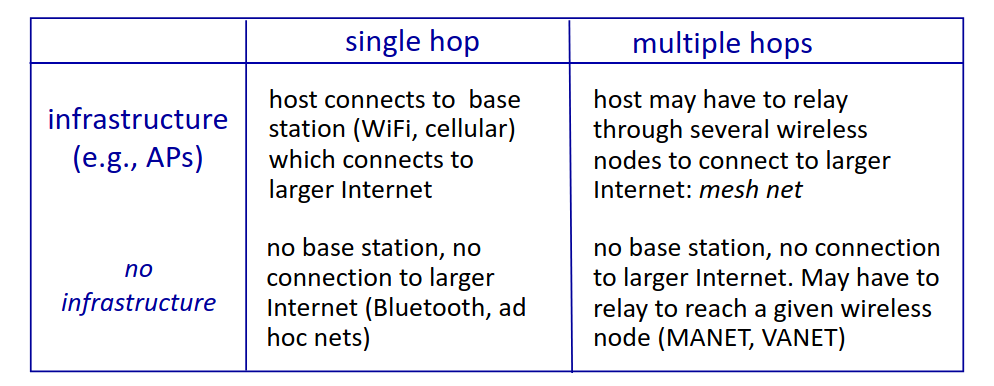
Infrastructure mode (BSS)
- base station connects mobiles into wired network
- handoff: mobile changes base station providing connection into wired network
Ad hoc mode (IBSS)
- No base stations
- Nodes can only transmit to other nodes within link coverage
- Nodes organize themselves into a network: route among themselves
Wireless link characteristics
Fading (Attenuation): -> Wireless radio signal attenuates (loses power) as it propagates (free space “path loss”)
Multipath:
-> radio signal reflects off objects ground, built environment, arriving at destination at slightly different times
-> Coherence time:
- amount of time bit is present in channel to be received
- influences maximum possible transmission rate, since coherence times cannot overlap
- inversely proportional to frequency and receiver velocity
Noise: -> interference from other sources -> larger SNR(signal-to-noise-radio) – easier to extract signal from noise -> SNR might change with mobility
Hidden Terminal Problem (Nó Escondido)
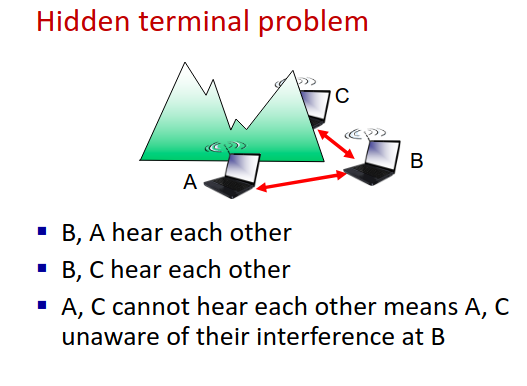
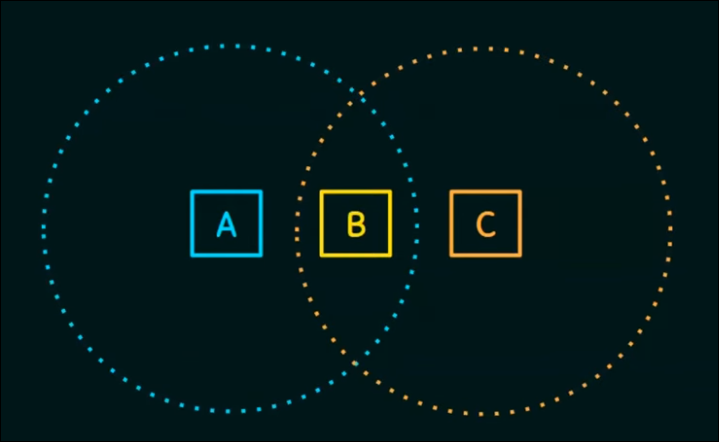
- The coverage area of A does not detect C, and the coverage area of C does not detect A
- If A sends data anywhere C does not detect that data being sent
- Both A and C detect B, because is in their coverage area
- So B can transmit to both, but A and B can not transmit to each other
Problem: A and B decide to send a frame to B at the same time
- A collision occurs at B, because A and C are unaware of each other (and are unaware of this collision because is wireless)
- A anc C are hidden in respect to each other
Solution: -> RTS and CTS
Exposed Terminal Problem (Nó Exposto)
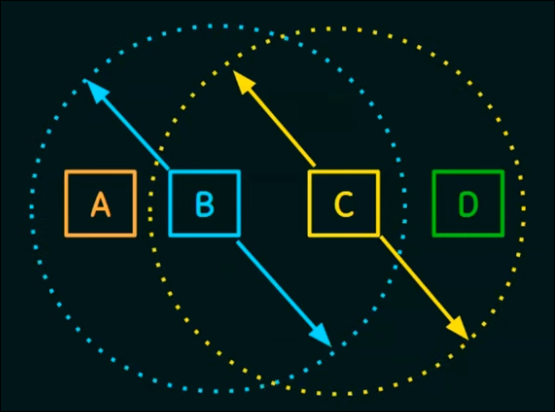
- B and C are aware of each other
- A and C are in the coverage area of B
- B and D are in the coverage area of C
Problem: B sends to A and C is aware of this communication so it does not send anything because is preventing collisions. Though C could send to D.
Solution: RTS and CTS
802.11 Wireless LAN
Architeture
- wireless host communicates with base station denominated access point (AP)
Basic Service Set/cell (BSS): -> wireless hosts -> access point (AP): base station -> ad hoc mode: hosts only
Extended Service Set: -> include one or more BSS
Channels
- spectrum divided in two at diffent frequencies
- Admin of the AP decides frequency
- Interference may occur for neighborhoods with same frequency
Association
- Arriving host: must associate with an AP
- scans channels, listening for beacon frames containing AP’s name (SSID) and MAC address
- selects AP to associate with
- then may perform authentication before association
- then typically run DHCP to get IP address in AP’s subnet
Avoiding Collisions
- idea: sender “reserves” channel use for data frames using small reservation packets
->sender first transmits small request-to-send (RTS) packet to BS using CSMA
- RTSs may still collide with each other (but they’re short) -> BS broadcasts clear-to-send CTS in response to RTS -> CTS heard by all nodes
- sender transmits data frame
- other stations defer transmissions
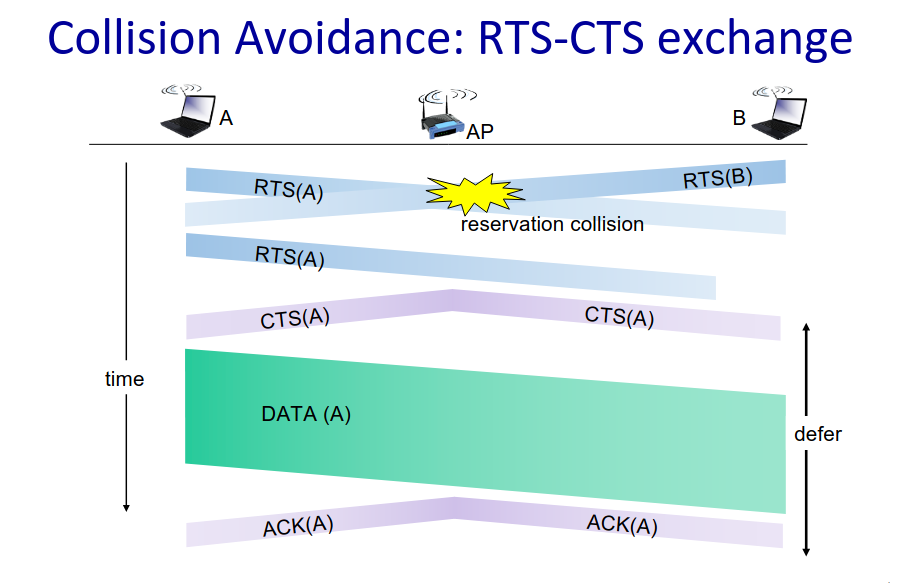
NOTE: ->ACK - pacote TCP que confirma a recepção de uma mensagem ou de um conjunto de pacotes -> CTS (Clear to Send) - é um quadro de controlo utilizado no protocolo MAC (Media Access Control) para garantir a transmissão de dados de forma ordenada, evitando colisões e interrupções.
Frame Addressing:

- duration - Reserved transmission time (RTS/CTS)
- address 1 - MAC of AP that receives the frame
- address 2 - MAC of AP transmitting the frame
- address 3 - MAC of Router which AP is attached
- address 4 - Used only in ad hoc mode
- seq control - Frame sequence # (for reliable data transfer)
Frame Types
Management Frames: -> Perform supervisory functions (joining, leaving wireless networks; moving AP to AP)
Control Frames: -> Perform control operations in conjunction with data frames -> Allow to deliver data reliably from STA to STA.
Data Frames: -> Send data from STA to STA.
Mobility Within Same Subnet
- H1 remains in same IP subnet: IP address can remain same
- Switch: as it is self-learn, will see frame from H1 and “remember” which switch port can be used to reach H1
Advanced Capibilities
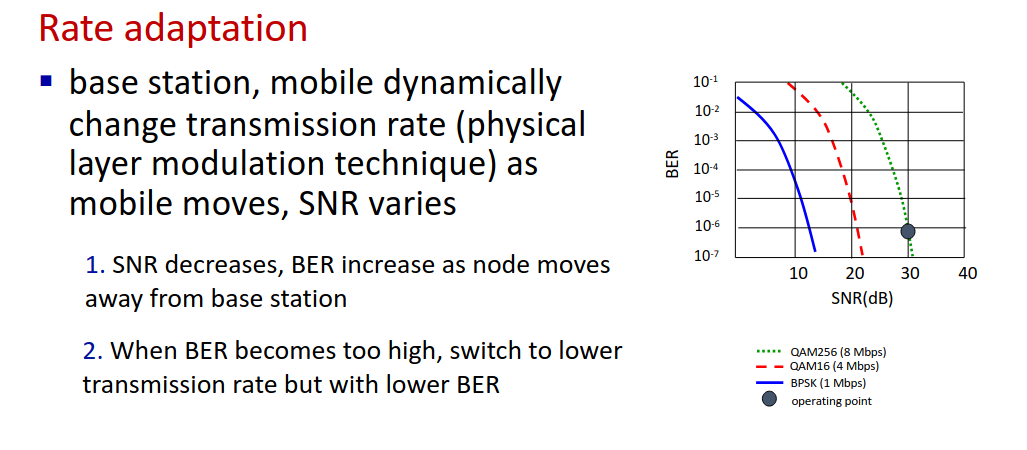
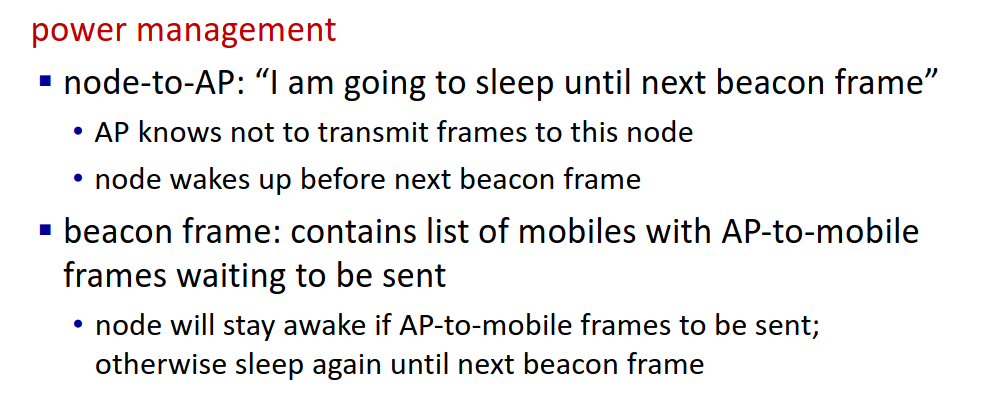
Mobility in cellular data networks:
-
Direct routing:
→ Refers to when the communicating node (e.g., a mobile device) sends data directly to the destination without passing through a fixed intermediate point. → although it reduces some hops, can be more complex and less scalable because the end nodes need to maintain dynamic and updated information about the location of mobile devices. → can suffer from overhead in maintaining dynamic routes, especially in large and mobile networks -
Indirect routing:
→ Data passes through an intermediate node, such as a Home Agent in Mobile IP, which acts as a fixed point in the network and forwards packets to the mobile device -> (using fixed nodes like Home Agents) helps manage mobility and location of devices, making routing easier even when devices change networks
| Routing Type | Scalability | Comment |
|---|---|---|
| Indirect | Better | Uses intermediate nodes to manage mobility |
| Direct | Worse | Requires end nodes to constantly update, more complex at large scale |
- SSID(Service Set Identifier) - Name of wifi netwrok
- Um SSID identifica um Extended Service Set (ESS), que pode ser composto por um ou mais pontos de acesso (APs) que juntos formam a rede Wi-Fi.