- A packet can be transmitted on a link: -> If there is no other packet currently being transmitted on the link -> If there are no other packets preceding it in the queue
Processing Delay
- Time required to examine the packet’s header and determine where to direct it
- Time needed to check for bit-level errors in the packet
- On the order of microseconds or less.
Queuing Delay
- Time spent waiting in the queue to be transmitted
- Occurs when packet arrival rate exceeds output link capacity
- Depends on the number of earlier-arriving packets (congestion level)
- If when arriving the queue is empty than the queuing delay is zero
- On the order of microseconds to milliseconds in practice
Transmission Delay
- L/R seconds -> L = packet length in bits -> R = transmission rate in bits/second
- Time required to push (that is, transmit) all of the packet’s bits into the link.
- On the order of microseconds to milliseconds in practice
Propagation Delay
-
Time required to propagate from the beginning of the link(in router/host A) to router/host B
-
The bit propagates at the propagation speed of the link that depends on the physical medium (fiber optics, twisted-pair copper wire, ...). Differs from the range of: $$ 2 .10^8 \ meters/sec \ \ to\ \ 3.10^8 \ meters/sec $$
-
d/s -> d = distance between two routers -> s = propagation speed of the link
-
On the order of milliseconds
Comparing Transmission and Propagation Delay
Transmission delay -> time required for the router to push out the packet in function of the packets length and the links's transmission rate. Has nothing to do with the distance between the routers/hosts.
Propagation delay -> time it takes a bit to propagate from one router to the next in function of distance between the two routers/hosts. Has nothing to do with L or R.
Caravan Analogy:
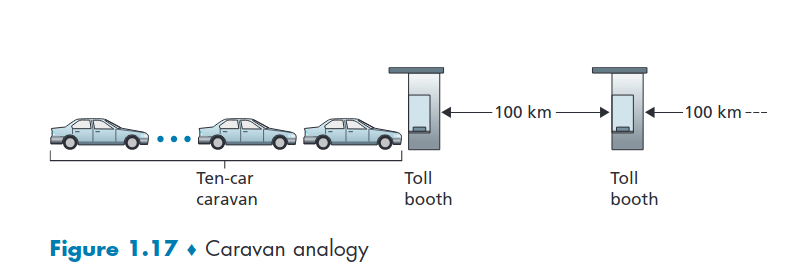
Imagine a highway with tollbooths(portagens)(routers), in which 10 cars(bits) circulate as a caravan(10bit-packet) -> Every time a car gets to a tollbooth it waits for the others before parting. -> The tollbooths are all at a distance of 100km -> Suppose that that there is no traffic and the caravan is the only in the highway -> Suppose that every time a car leaves a tollbooth it travels(propagates) at a constant speed of 100km/h until it gets to the next tolbooth. -> Suppose that each tollbooth services a car at a rate of 1 car per 12 seconds(transmission rate)
- The time required for the tollbooth to push the entire caravan onto the highway(transmission delay) is (10 cars)/(1cars/12seconds) = 120 sec = 2 minutes
- The time required for a car to travel from the exit of one tollbooth to the next tollbooth is 100 km/(100 km/hour) = 1 hour = 60 minutes
- Therefore, the time from when the caravan is stored in front of a tollbooth until the caravan is stored in front of the next tollbooth is the sum of trans-mission delay and propagation delay—in this example, 62 minutes.
Summary
Nodal delay-> the delay at a single router: $$ d_{nod}= d_{proc}+d_{queue}+d_{trans}+d_{prop} $$
- Processing Delay -> typically a few microsecs or less
- Queuing Delay -> depends on congestion very hard to caculate
- Transmission Delay -> L/R, significant for low-speed links
- Propagation Delay -> d/s, a few microsecs to hundreds of msecs
1.4.2 -Queuing Delay and Packet Loss
-
The queuing delay can vary from packet to packet.
-
If 10 packets arrive at an empty queue at the same time, the first packet transmitted will suffer no queuing delay, while the last packet transmitted will suffer a relatively large queuing delay
-
When characterizing queuing delay, one typically uses statistical measures, such as average queuing delay, variance of queuing delay, and the probability that the queuing delay exceeds some specified value.
-
R = link bandwidth (bps)
-
L = packet length (bits)
-
a = average packet arrival rate
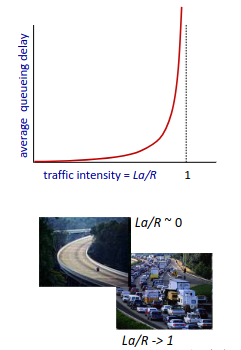
traffic intensity = arrival rate of bits / service rate of bits = a. L/R
-> If La/R ~= 0 : average queuing delay small -> If La/R <= 1 : delays become large -> If La/R > 1 : more "work" arriving than can be serviced, average delay infinite!
Packet Loss
- queue(buffer) preceding link in buffer has finite capacity
- packet arriving to full queue dropped (lost)
- lost packet may be retransmitted by previous node, by source end system, or not at all
- The fraction of lost packets increases as the traffic intensity increases
1.4.3 End-to-End Delay
The nodal delays accumulate and give an end-to-end delay:
$$ d_{end - end} = N .(d_{proc} + d_{trans} + d_{prop} ) $$
Traceroute
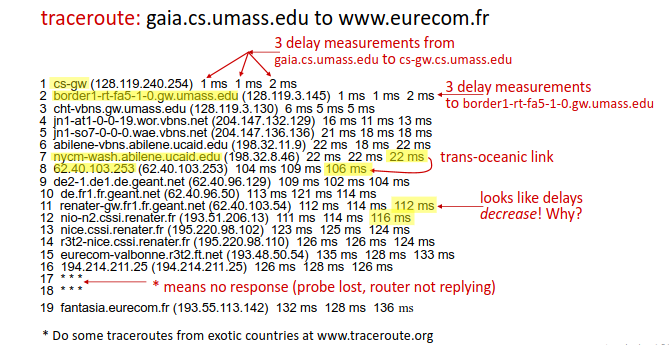
Traceroute Program: provides delay measurement from source to router along end-end Internet path towards destination. For all i: -> sends three packets that will reach router i on path towards destination (with time-to-live field value of i) -> When reaching router i, it returns the packets to the source end system (sender host) -> sender times interval between transmission and reply (elapse time from host to i) sending another 3 packets to the next router (i+1). repeating this process until finding destination

- Sometimes traceroute can show less time for a further router than for a previous closer one. That's because the traffic can be less busy than before, the queuing time may vary.
1.4.4 - Throughput in Computer Networks
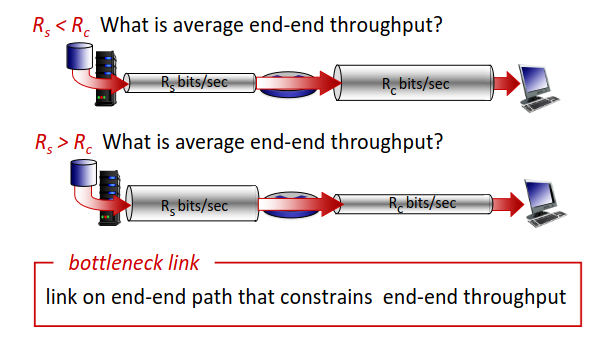
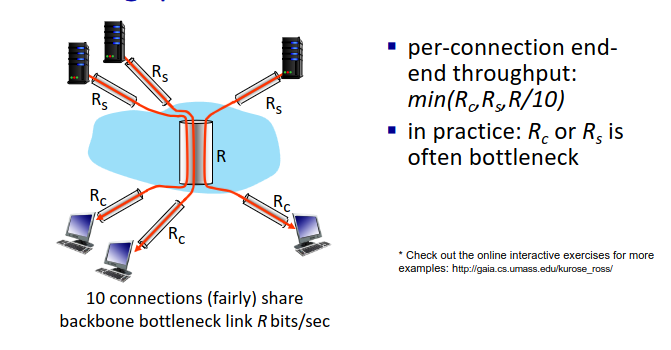
Throughput -> rate(bits/time unit) at which bits transferred between sender/receiver. All pipeline -> instantaneous: rate at an instant of time (bps) at which Host B is receiving a file -> average: rate over long(er) period of time (bps)
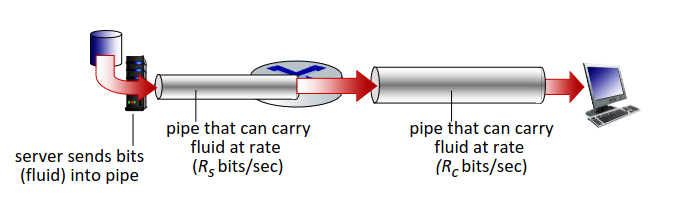
Rs -> rate of the link between the server and the router Rc -> rate of the link between the router and the client
- what is the server-to-client throughput? To answer this question, we may think of bits as fluid and communication links as pipes.
-> If Rs < Rc, then the bits pumped by the server will “flow” right through the router and arrive at the client at a rate of Rs bps -> If Rc < Rs, then the router will not be able to forward bits as quickly as it receives them. end-to-end throughput of Rc.