- Important information to run/resume processes that are Ready to execute is kept in main memory
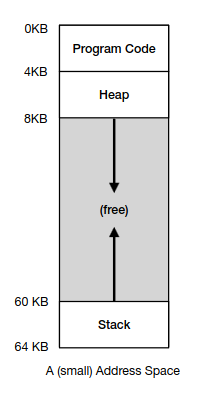
- The memory state of a process is kept at the Address Space -> Code: the instructions of the program -> Stack: local variables, arguments of routines, return values -> Heap: dynamically allocated memory
Memory API
Stack → allocations and dellocations are handled by the compiler Heap → allocations and dellocations are handled by the programmer explicitly
Malloc: -> allocates memory dynamically accordingly to the size passed as an argument -> forgetting to allocate memory may lead to segmentation fault -> not allocating enough memory may lead to buffer overflow -> forgetting to initialize allocated memory may lead to program bugs
Free: -> returns previously allocated memory that is no longer being used ->freeing memory before being done with leads to crashes or overwrites in invalid memory ->freeing memory repeatedly leads to double free -> calling free() incorrectly leads to craches or freeing other allocated memory
- malloc() and free() are not system calls, are library calls, build on top of system calls such as brk and sbrk that change the size of heap
Virtualizing Memory
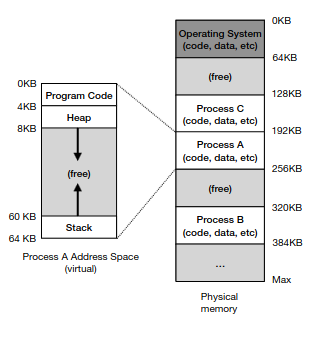
- The address space of Process A is not really loaded into physical memory at addresses 0 to 64KB
-> When Process A accesses address 0 (virtual address), the request is mapped to address 192KB at main memory (physical address)
-
The Goals of the OS are: -> Transparency: Each process behaves as if it has its own private physical memory, not knowing it is being virtualized -> Efficiency: Memory virtualization must be efficient in terms of performance and space -> Protection: Processes cannot access/modify memory regions from other processes or the OS
-
To ensure transparency each memory access (e.g., fetch, load, store) done by a process uses a virtual address that must be translated, by the hardware, into the corresponding physical address (i.e., actual location in memory)
-
The OS is responsible for instructing the hardware to do the correct translations, managing memory, and protecting processes from each other
Base and Bounds (or Dynamic relocation)
- The CPU has two additional register, the base and the bounds that help with address translation and are kept at the Memory Management Unit (MMU)
- The memory virtualization illusion created by the OS consists of each program being written and compiled as if its loaded at address 0, but actually when the program starts the OS sets the base register where it decides to load it in physical memory.
- For each memory access made by the program, virtual addresses are translated into physical ones, by the processor, in the following way
$$ Physical:address = Virtual : address + Base $$
- The bounds register helps protecting the address space limits of processes
- The processor first checks if the memory is within bounds and if not sets a out of bounds exception trap.
- Given that the translation is done in runtime, a process's address can be dynamically reallocated. The OS copies its address to another physical location.
- Base and bounds registers must be saved and changed when processes are switched
Internal Fragmentation
- Placing address space contiguously in physical memory leads to internal fragmentation, wasted memory inside the address space of a process. Allocating a fixed sized block of memory to a process that doesn't use all of it. Ex: Supposing that the OS uses fixed-size memory blocks of 4KB -> A process needs 3.2KB -> The unused space 0.8KB is internal fragmentation
Segmentation
- Supposing that address space ain't stored contiguously but instead each logical segment (code,heap,stack) is placed at different physical memory region.
- Each segment can be realocated across memory as the system runs
- Context Switching requires saving and restoring these several base and bounds registers.
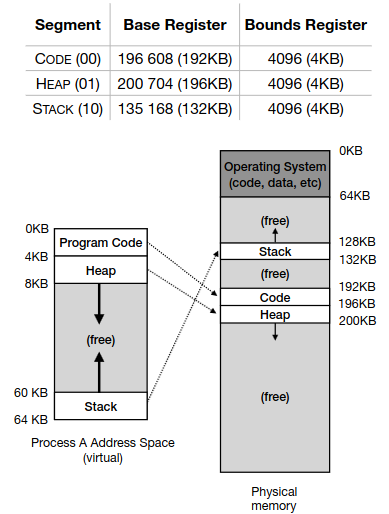
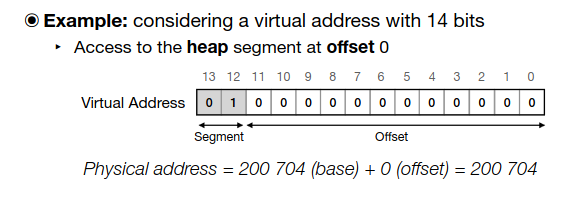
- For the hardware to know the segment and offset of a virtual address it uses the top bits of the virtual address (EX: 00 - code, 01 - heap, 10 - stack)
- The offset must be within bounds, in this case the between 0-4096 bytes
-
Segment Number → tells the hardware which segment (Code, Heap, stack)
-
Offset → tells the location within the segment
-
The hardware splits the virtual address into these two parts to : -> Identify the correct base address using the Segment Table -> and the offset to the base to get the final physical address -> Check if the offset is within bounds to prevent a segmentation fault
-
Stack grows backwards, in the example goes from from physical address 132KB to 128KB
-
Shared segments can happen across multiple processes, for example libraries code shared by multiple programs
-
Each process has its own registers
-
Protection bits(EX: read only in file opens)
-
Coarse-grained segmentation is a memory management strategy where each segment is relatively large
-
Fine-grained segmentation has smaller segments and requires a segment table for translating the segments physical addresses
External Segmentation
- Since segments vary in size, physical memory can quickly be filled with several little holes, leading to external fragmentation
- Constantly stopping and realocating memory is costly so we use a free list management strategy
Free List
- A free list contains the addresses and length of free chunks at physical memory
- Each node represents a free memory block with its size and a pointer to the next free block
- Used by allocators like
mallocto find space for new allocations.
Splitting:
- When a large free block is found for an allocation request, it may be split into:
-> One part that satisfies the request
→ Another smaller block that remains on the free list
EX:
Request = 100 bytes
Free block = 256 bytes
→ Split into 100 bytes (allocated) + 156 bytes (free) - Prevents internal fragmentation
Coalescing:
-
When free blocks are adjacent in memory, they can be merged (coalesced) into one larger block.
-
prevents external fragmentation and reduces smaller unusable free blocks
-
usually done when: -> a block is freed -> periodically by the allocator
-
The free list is stored in heap memory itself — specifically, within the free blocks it manages.
-
Each free block contains a small header including its size and pointer to the next free block, making the free list self contained
Best Fit:
- Go through the list and find the smallest chunk that fits the requested size
Worst Fit:
- Go through the list and find the largest chunk that fits the requested size
- Leads to excess external fragmentation
First Fit:
- Best and Worst fit strategies requires going through the full list to find a candidate. This may take some time
- First fit looks for the first free chunk that is large enough to accommodate the request
- fast but, leads to severe external fragmentation thorugh many splliting
Next fit:
- Next fit looks for the first free chunk that is large enough to accommodate the request, but records the last chunk being split at the free list. When a new allocation is needed, the search starts from such position onwards.
- Avoids small fragments at the list’s beginning
Segregated Lists
- Slab Allocator is a memory management technique used in operating systems to efficiently allocate memory for objects of the same size, by preallocating memory chunks(slabs) for specific object types. Reducing memory fragmentation and speeding up allocation.
- Slab → A chunk of contiguous memory preallocated for storing objects of one type (e.g., task structs, file descriptors)
Buddy Allocation
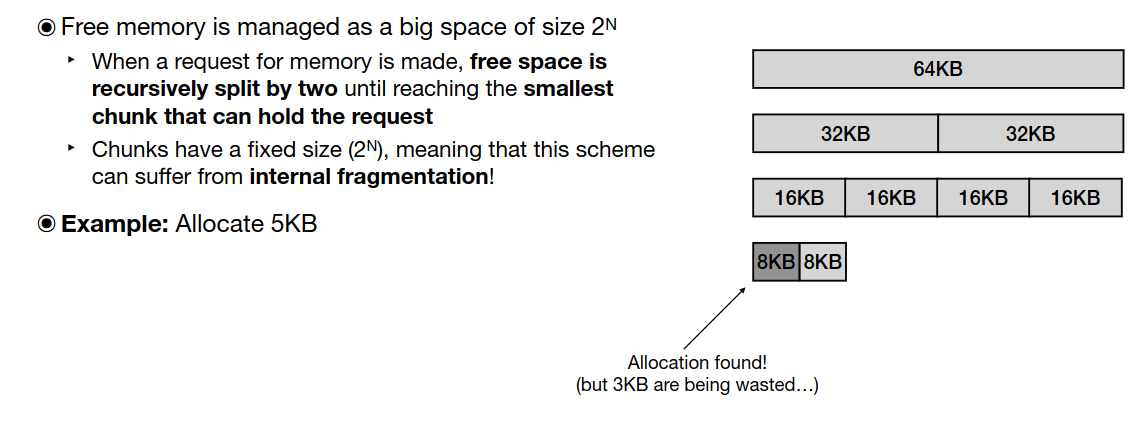
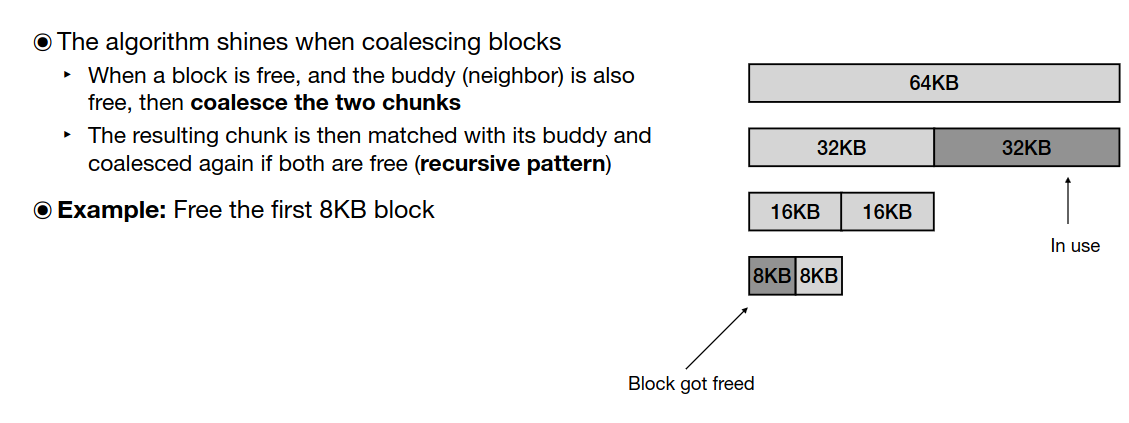
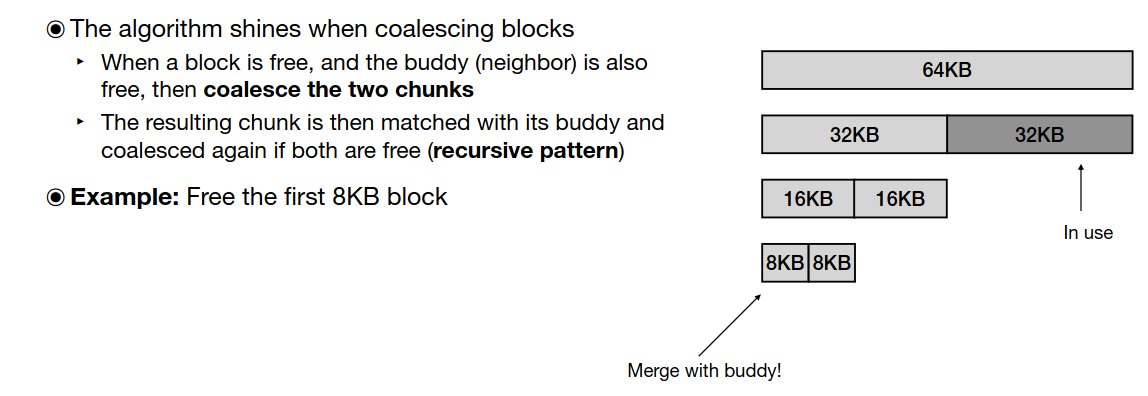
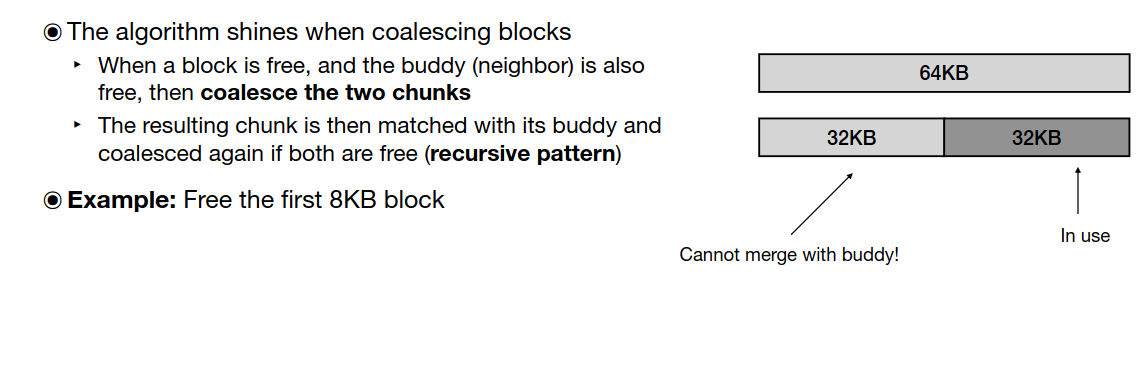
- Buddy allocation is a memory management algorithm that efficiently allocates and frees memory in blocks that are powers of two. It's commonly used in operating systems (e.g., Linux kernel) for allocating physical pages or managing large contiguous memory regions.