- The PCBs of Ready Processes are kept in a Ready Queue
- The OS scheduler is responsible for choosing the next process to execute
- The Workload is the set of running processes
- A process can also be called job
Turnaround Time
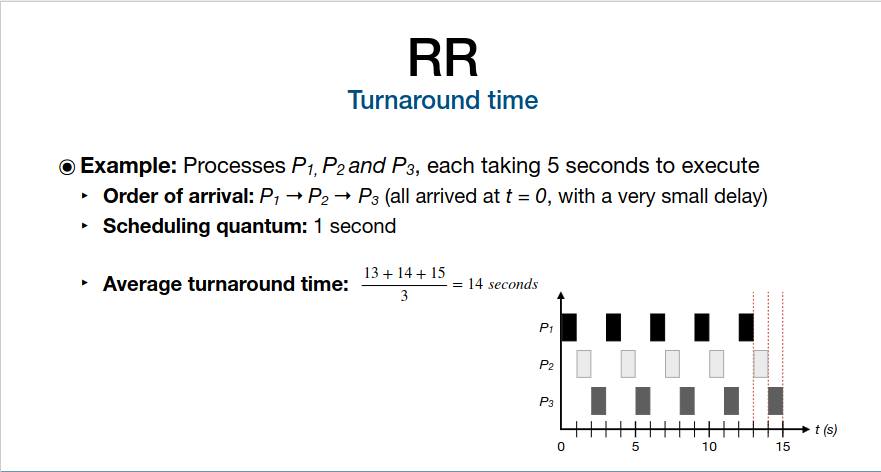
- Time the process takes to complete after arriving in the system
- Is a performance metric
- The smaller the average turnaround time the better
$$ T_{turnArount}= T_{completion} - T_{arrival} $$
- There are other non-performance metrics used by the scheduler (CPU utilization - OS keeps the CPU running useful instructions, Fairness - all processes get a chance to execute)
FCFS (or FIFO) - First Come First Server
-
Selection criteria: Schedule the process that arrived first (earlier)
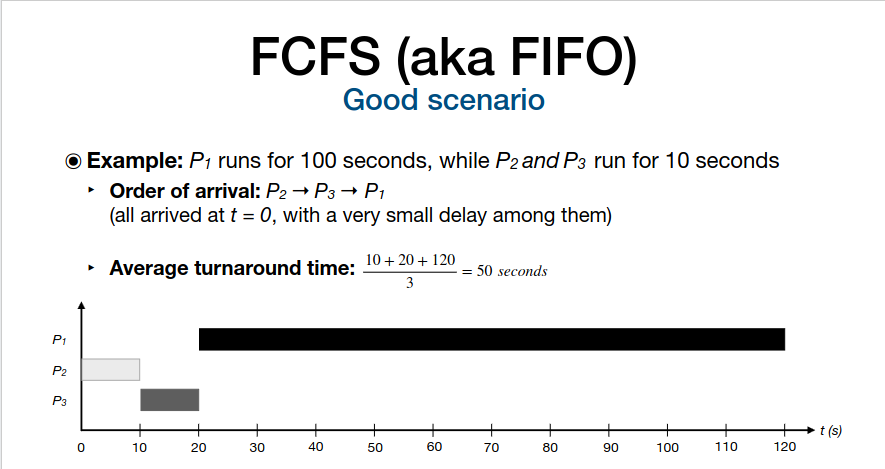
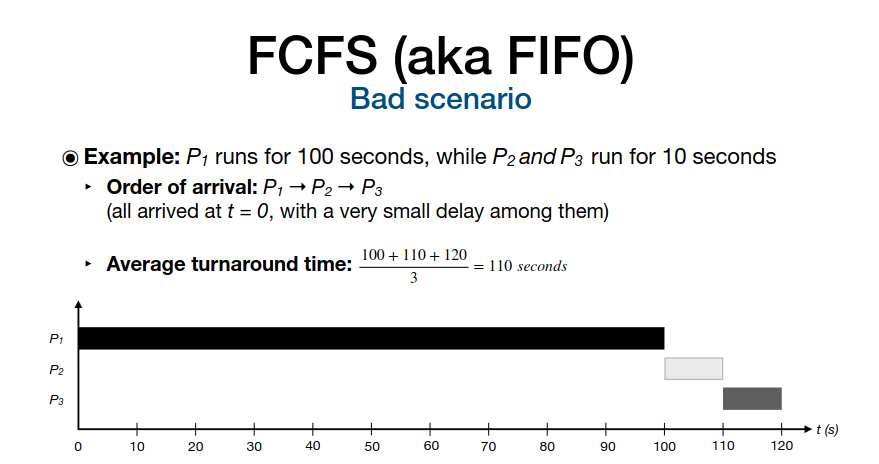
-
Convoy effect: short consumers get queued behind a heavyweight one
SJF (Shortest Job First)
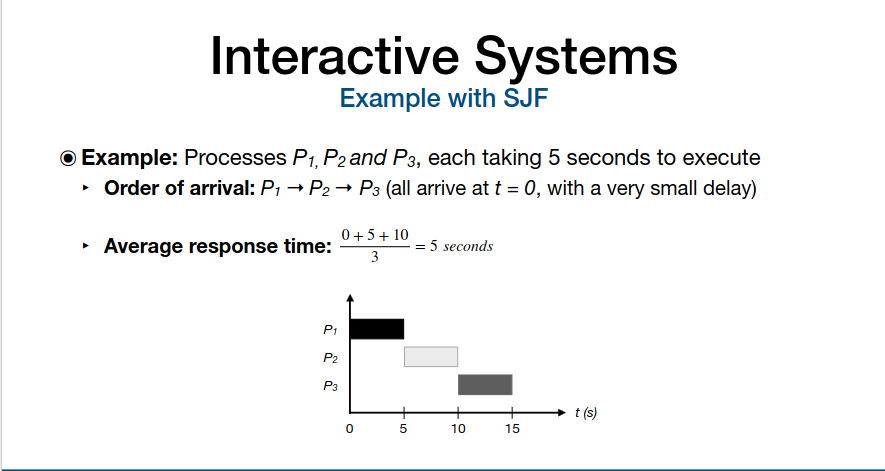
- Selection criteria: Run the process with the shortest runtime, then the next shortest, …
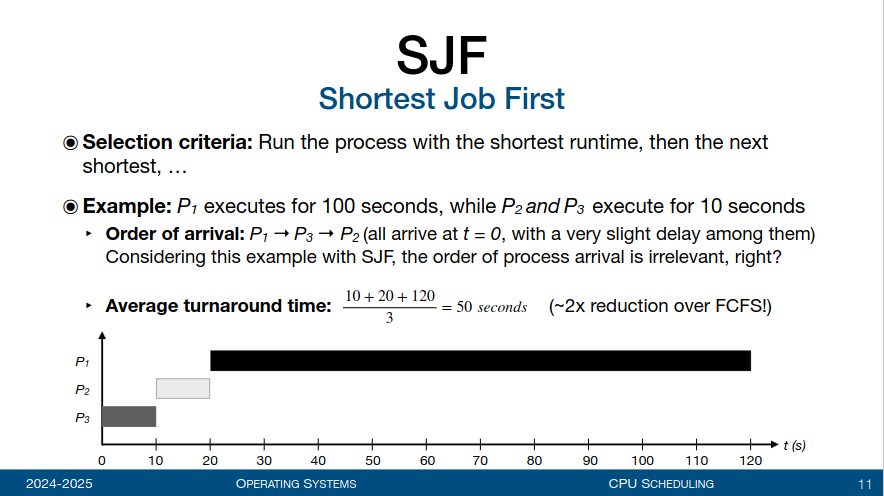
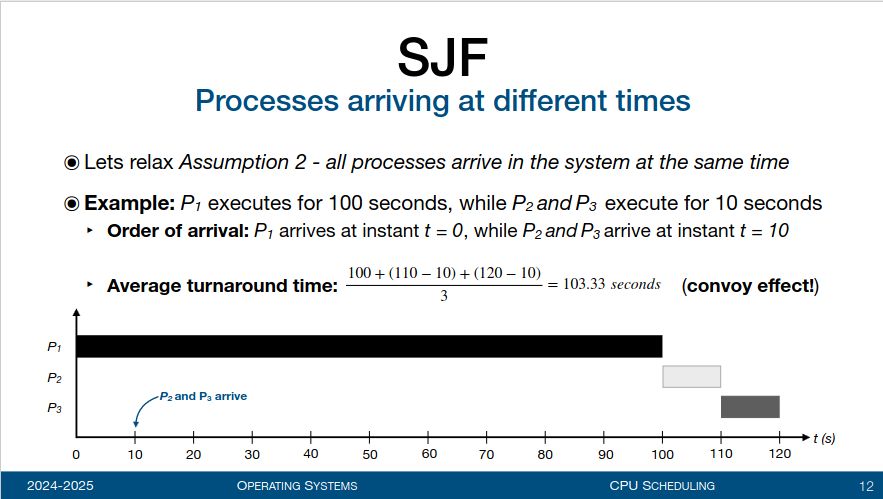
- SJF is a non-preemptive scheduler - processes run until they yield the CPU
- So the Scheduler must preempt P1 and run another process, combining timer interrupt with context switching mechanisms
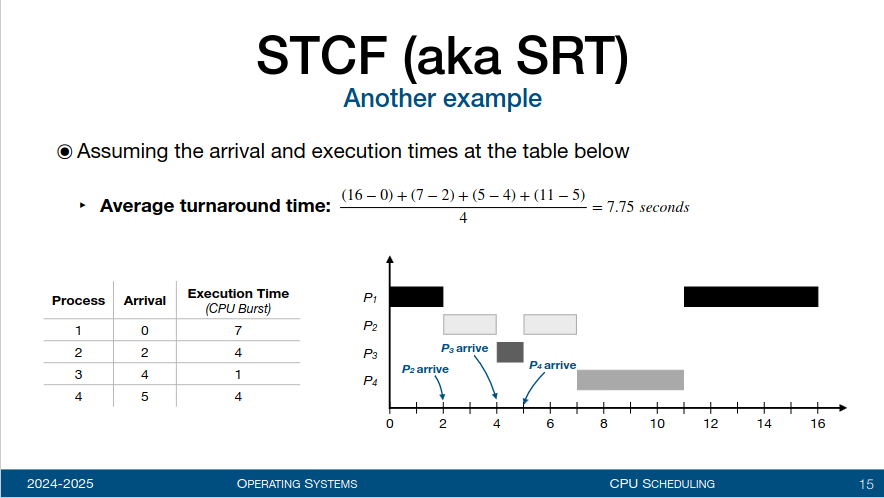
STCF (or SRT) - Shortest Time-to-Completion/Shortest Remaining Time
- Selection criteria: Anytime a new process enters the system, schedule the process with the least (shortest) runtime left
Response Time
- With time-shared computers, users started asking for interactive performance (time from when the process arrives in the system to the first the it is scheduled)
$$ T_{response}= T_{firstRun} - T_{arrival} $$
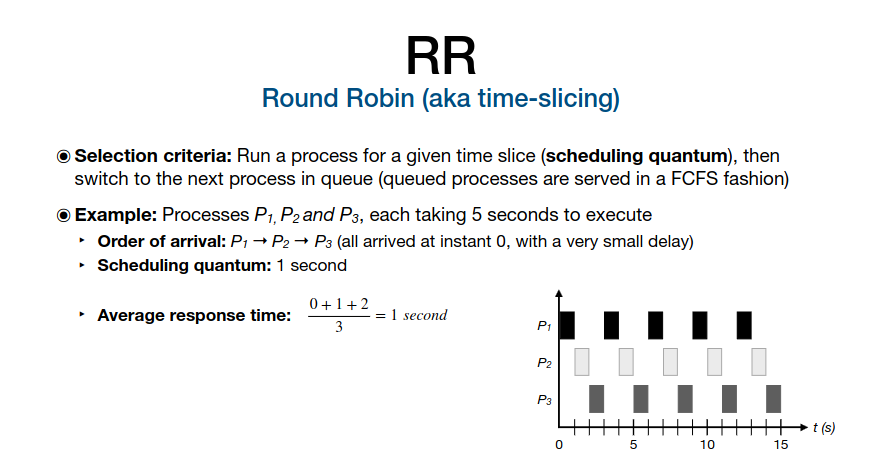
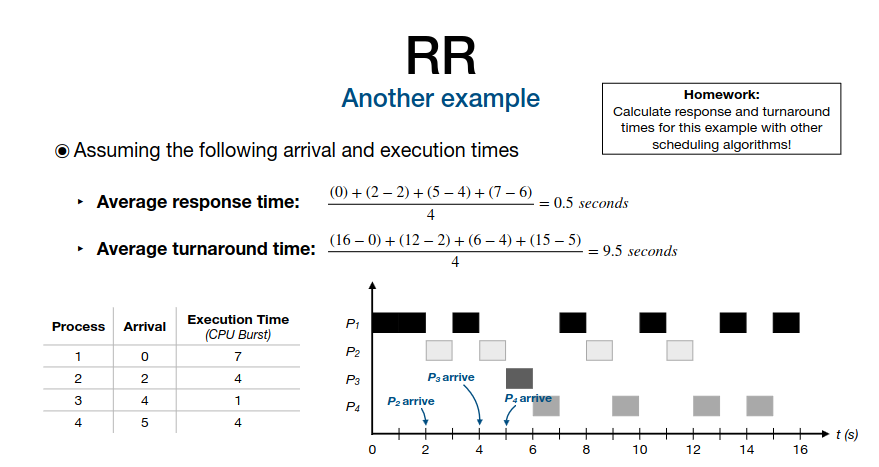
RR - Round Robin/Time-Slicing
Selection criteria: Run a process for a given time slice (scheduling quantum), then switch to the next process in queue (queue processes are served in a FCFS fashion)
-
The scheduling quantum is critical for RR’s efficiency
-> Short values - better response time
-> Large values - similar to a FCFS policy -
However small scheduling quantum can have a time of context switching that can dominate the overall performance, so the duration os the scheduling quantum must amortize the cost of context switching Ex: -> scheduling quantum = 10 ms and context-switching = 1ms - 10% wasted time ->scheduling quantum = 100 ms and context-switching = 1 ms - 1% wasted time
Summary
-
FCFS (FIFO) ->Simple and easy to implement!
->Turnaround time is very sensitive to the processes order of arrival -
SJF and STCF
-> Both improve turnaround time. STCF is better when processes arrive at distinct times
-> Both require knowing runtime in advance, and are bad when considering response time -
RR
-> A fair scheduler, good for improving response time (important for interactive systems)
-> One of the worst algorithms for turnaround time (fair algorithms are bad for this metric) -
Tradeoff between optimizing turnaround time and response time
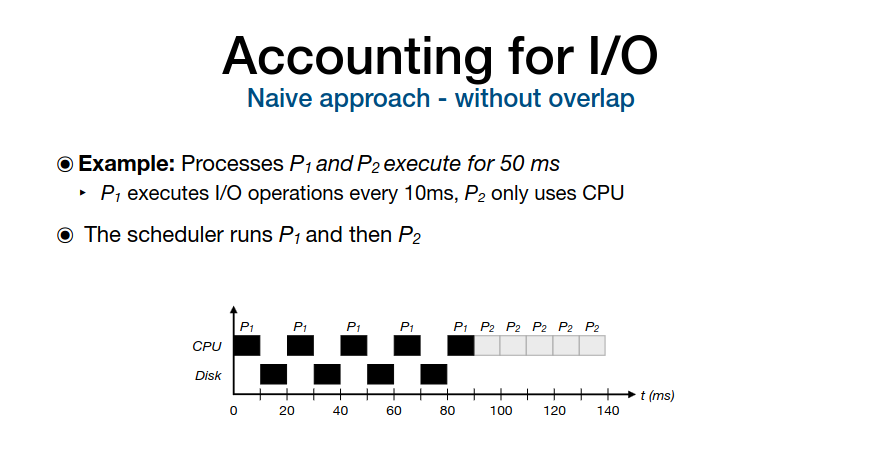
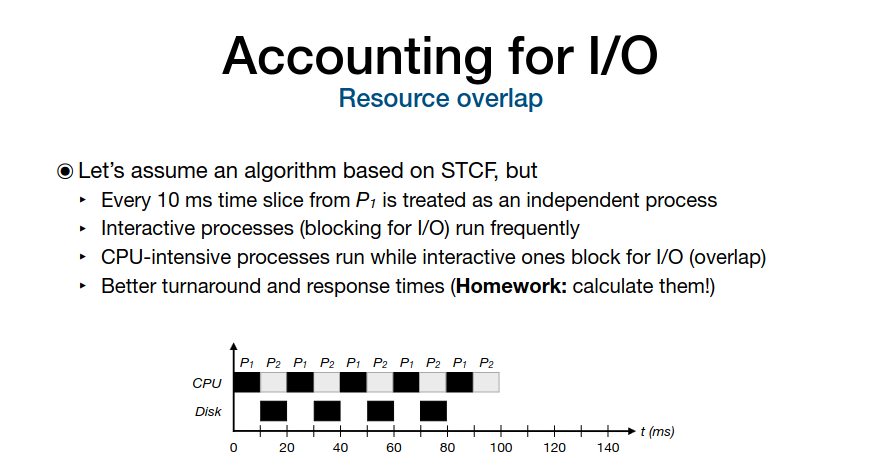
Accounting for I/O
MLFQ (Multi-Level Feedback Queue)
- The runtime of processes is not know
- Combines good turnaroud time like SJF and STCF and good response time like RR.
- Multiple queues, ordered according to their priority
- If two processes priorities are the same, then they run in RR
Assigning Priorities: → Compensate processes that relinquish CPU frequently → Demote processes that are CPU intensive
Allotment: the amount of time a process can spend at a given priority level
- The time slice for each queue(priority level) may change - longer time slices have low priority queues
Priority Rules:
→ Rule 1: If Priority(P1) > Priority(P2), P1 runs (P2 does not)
-> Rule 2: If Priority(P1) = Priority(P3), P1 & P3 run in RR
→ Rule 3: When a process enters the system it has the highest priority (top queue)
→ Rule 4: Once a process uses up its time allotment at a given level, its priority is reduced (i.e., moves down one queue))
→ Rule 5: After a time period S, move all the jobs to the topmost queue
- When new processes with higher priority arrive, low priority processes executing are preempted
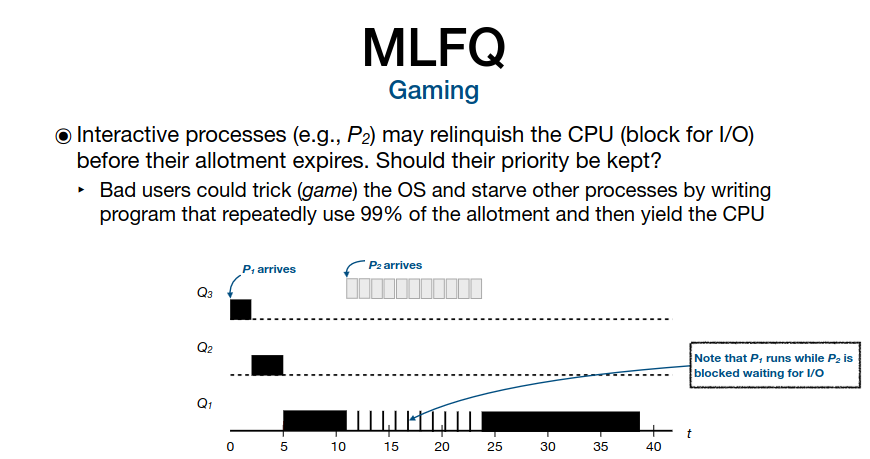
→ Rule 4 (UPDATED): Once a process uses up its time allotment at a given level (regardless of how many times it has given up the CPU), its priority is reduced (i.e., moves down one queue
Summary
- Short duration processes run with high priority (approximates STCF)
-> Good for turnaround time - High priority processes are frequently switched (approximates RR)
-> Good for response time - Challenge: several tuning knobs in MLFQ
-> How many queues?
-> How long should the allotment time per queue be?
-> When should the priority boost be called? - No easy answer
-> One must know the OS and workloads running there
CFS
- Virtual runtime (vruntime): counts the CPU time used by a given process and is incremented every time a process uses the CPU
- Selection criteria: choose the process with the lowest vruntime
- Vruntimes are indexed in a red-black tree (balanced tree) to efficinetly choose the next to run